The Growth Trap of Page Builders: When Pre-made WordPress Templates Hold Back SMEs and Custom Development Becomes Mandatory
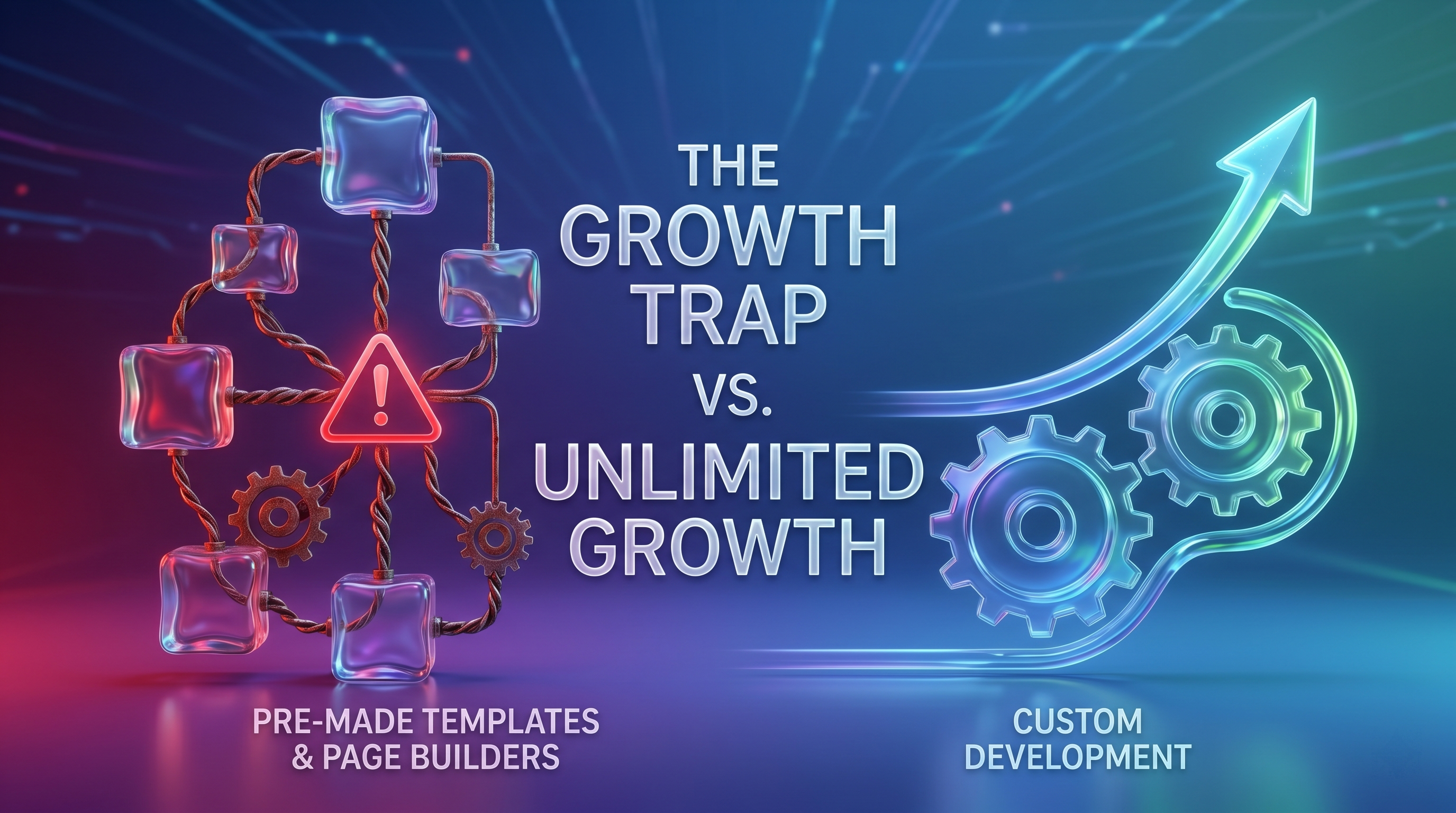
The digital presence of an established small and medium-sized enterprise (SME) has radically changed in recent years. In 2026, the website is no longer a static, purely informative business card, but the central, interactive nervous system for all inbound marketing, sales, and employer branding. In the modern, highly competitive digital economy, factors like microsecond loading times, absolute system stability under heavy load, and seamless integration into existing ERP and CRM systems determine measurable economic success.
Despite this business-critical importance, a frighteningly high number of web presences of established companies—including highly demanding law firms and technologically specialized IT service providers—are based on architectural foundations that are completely inadequate for their needs: pre-made WordPress templates and clunky visual page builders.
This article provides a ruthlessly objective, technologically sound analysis of the often-concealed disadvantages of ready-made templates. We highlight the direct custom WordPress theme vs. template comparison and show why the step towards tailored custom development is not a luxury decision for ambitious SMEs, but a highly profitable strategic investment to secure competitiveness.
The Lifecycle of a Corporate Website: From Agile MVP to Limiting Bottleneck
The technological architecture of a website usually runs parallel to the economic maturity of the company. What initially seemed like a smart, budget-friendly solution inevitably mutates into a limiting factor as traffic and complex processes increase.
1. The Founding Phase: The Minimum Viable Product (MVP)
In the startup phase, limited budgets and the quick proof of market viability dominate. Here, resorting to cheap premium themes (e.g., from ThemeForest for 50 to 100 euros) combined with visual page builders like Divi or Elementor is absolutely legitimate. The goal is the rapid avoidance of digital invisibility with minimal capital investment.
2. The Growth Phase: The Accumulation of Technical Debt
Once the company enters a stable growth phase, the website transforms into a measurable revenue driver. This is where the structural cracks in pre-made themes begin to show. To retrofit missing features (like complex forms or API interfaces), countless third-party plugins are installed. The code base becomes inconsistent, every core update carries the risk of system failures, and loading times deteriorate dramatically. The system becomes sluggish.
3. The Maturity and Expansion Phase: The Page Builder as an Existential Trap
When the company reaches significant annual revenues and complex sales processes, the page builder architecture becomes an acute threat. Seamless multilingualism, latency-free interfaces (Salesforce, DATEV), or granular user roles cannot be mapped with mass-market themes. Every attempt at customization ends in unstable workarounds. At this point, a strategic system rebuild through professional custom development becomes mandatory.
Target Group-Specific Risks: IT Service Providers and Law Firms
The limitations of templates become particularly evident in industries with extremely high quality and security standards:
- Lawyers & Law Firms (YMYL & GDPR): Google classifies law firms in the "Your Money or Your Life" (YMYL) category. The requirements for expertise and trust (E-E-A-T) are extremely high. An interchangeable template undermines the elite claim. Even more critical is data protection: the integration of client portals or the transmission of sensitive case data require the highest, tailor-made security standards. A ready-made WordPress theme disadvantages profile is particularly evident here in the dependence on insecure third-party plugins, which poses a massive liability risk.
- IT Service Providers: It is a sales paradox to try to sell high-performance cloud infrastructures to external clients while your own website is based on a cobbled-together page builder. A scalable website for IT service providers must demonstrate technological excellence, clean code, and lightning-fast loading times as a proof of concept.
The Technical Deconstruction: Why Page Builders Fail at Performance
Commercial ready-made themes are programmed to offer every buyer worldwide every design option—without them having to write code. This "universality" in the frontend is bought with massive efficiency losses in the backend.
The Phenomenon of Code Bloat
The most serious weakness of visual builders is the code bloat of WordPress page builders. Systems like Elementor load their entire, resource-hungry rendering engine on every single subpage, including dozens of unused JavaScript and CSS files. The end customer's browser is forced to download, parse, and execute hundreds of kilobytes of technological ballast before the actual content becomes visible.
DOM Depth and Main Thread Blocking
Page builders use cumbersome container structures ("nested divs within nested divs") to display responsive layouts via drag-and-drop. This excessive DOM depth forces the end device's processor to perform enormous calculations. The browser's main thread is blocked, which leads to noticeable stuttering, especially on mobile devices.
| Architecture Approach | DOM Depth | Main Thread Load | Code Generation |
|---|---|---|---|
| Elementor / Divi | Very high (heavy nesting) | High (blocking due to JS rendering) | Proprietary, wrapper-heavy |
| Gutenberg (Native) | Low (direct block output) | Low to Moderate | Native, standardized |
| Custom Theme | Minimal (only essential nodes) | Minimal (highest efficiency) | Semantic, manually optimized |
Core Web Vitals (CWV) in 2026: Disastrous Effects on SEO
Google ruthlessly evaluates websites according to the Core Web Vitals (LCP, CLS, INP). Page builder templates systematically fail here. While cleanly programmed custom themes achieve LCP values of under 1.5 seconds, unoptimized builder pages often measure over 5 seconds. The attempt to conceal this with countless caching plugins (e.g., WP Rocket) is often just papering over cracks in the foundation. Genuine WordPress performance optimization for SMEs starts at the code base.
The Parameters of Custom Development: The Foundation of Digital Excellence
A WordPress custom development (Custom Theme) is the transition from ready-to-wear mass goods to a tailor-made unique piece. The custom WordPress theme advantages are measurable and strategically decisive:
- Uncompromising Performance ("Clean Code"): Only scripts and queries that are strictly required are loaded. Improving loading times through WordPress custom development is not a slogan here, but inherent to the system. Response times of 0.5 to 1.5 seconds maximize conversion rates.
- Editorial Efficiency & Design Consistency: The backend is radically simplified. Using Custom Post Types and tools like Advanced Custom Fields (ACF), editors only maintain content in clearly defined fields. The layout is securely anchored in the code. No one can accidentally "break" the corporate design.
- Absolute Scalability: A custom architecture grows with you. Whether decoupled headless architectures (React, Vue.js), highly complex WooCommerce configurators, or encrypted DATEV interfaces—everything can be integrated with high performance.
- No Lock-in Effect (Shortcode Pollution): Page builders often encrypt content in proprietary shortcodes. If you change the theme, a ruin of cryptic code remains. Custom themes strictly separate the database (content) from the frontend (design).
The Business Perspective: TCO and Hidden Costs
Managing directors often make decisions based solely on initial development costs (CAPEX). A premium theme for $59 looks unbeatably cheap at first glance. However, a serious IT evaluation requires considering the Total Cost of Ownership (TCO) over 3 to 5 years—including maintenance, licenses, adjustments, and the dreaded "Rebuild Tax" (the forced rebuild of the system when the template collapses after a few years). What is initially more expensive in development (Custom Theme) becomes economically much more profitable over the years due to the elimination of expensive licensing fees and massively lower maintenance efforts.
The Invisible Threat: Opportunity Costs
The most severe cost factor does not appear in any accounting: Conversion losses. According to industry studies, every second of delay in loading time costs up to 7 percent of the potential conversion rate.
If an IT service provider records monthly B2B leads worth 100,000 euros, a performance lag of two seconds costs the company up to 14,000 euros in ungenerated pipeline value mathematically. A custom theme thus pays for itself through noticeably higher conversion rates and better SEO. Quality costs once; a lack of quality costs revenue every day.
Conclusion: The Structured Path to Digital Excellence
Maintaining a technologically fragmented page builder architecture operationally hinders growth and actively destroys digital enterprise value daily through poor performance. A urgently needed relaunch at this point must not be a cosmetic update, but requires a profound architectural realignment.
The strategic investment in excellent custom development is the only model that ensures the website makes the transition from a pure cost factor to a limitlessly scalable business asset.
Evaluate your current system architecture now.
Book a non-binding, in-depth strategy session with the specialists at top-wp.de. In this evaluation, we will deconstruct your current code base, measure the code bloat, and analyze how a strategic switch to a tailor-made custom development can unleash your company's growth. End the page builder compromise and secure your competitive advantage.